Friday, February 28, 2025

Technology Purchasing

Purchasing educational technology, especially a large purchase for a school or even a district, can be a daunting task. There must be a plan in place to guide leaders in the most effective way to do so. This is important because you definitely do not want to waste money, especially in the education world where money can be very hard to come by. The picture below lays out the steps that can be used to purchase educational technology (McLemore & Rae, 2024). 

NEEDFIND

According to McLemore and Rae (2024),  step one is to identify a specific need that can be filled using educational technology by doing a needs assessment. Hearrington (2024) discusses the fact that planning for anything new always requires data to support the reason for decisions that are made. As a part of the needs assessment, it is important to consider the edtech that the school or system already has and decide if it is still meeting a need or if it would be better to find something more useful that would fulfill that purpose. It is also very important the decision makers involved in this process are well aware of what is available and how any of it could possibly be a solution. To make all of this possible, data from current technology can be used, feedback from teachers and students should be considered, and there are conferences that can be attended with expo halls that allow for a chance to learn first hand about new educational technology that is available. The annual ISTE conference is a great example (McLemore & Rae, 2024). 

EVALUATE

The next step is to evaluate the potential technology and try to decide if it will meet the needs that the school or the system found that it had during the needs assessment. According to Miller (2020), it is important to consider the following:

  • Efficacy 
  • The student experience
  • Intrinsic motivation
  • Zone of proximal development
  • The teacher experience

PILOT

Piloting the chosen educational technology is an extremely important step. It is imperative to seek feedback from the students and teachers who will be using the edtech the most. After a trial period, there are several ways that feedback can be sought; surveys can be completed, interviews can be done, and observations can be utilized as well. All of this should provide the data needed to make decisions about whether to purchase the educational technology or not (McLemore & Rae, 2024). 

PURCHASE

The final step in the process, according to McLemore and Rae (2024), is to purchase and implement the educational technology. There are many sources of funding that could be available to help with a large purchase such as this, including government funding as outlined below. The processes for purchasing vary from district to district, but there are always very important steps to follow to make the process as smooth as possible. 


References

Frazier, M., Hearrington, D. (2024). Technology coordinator's handbook, Fourth edition: A guide to edtech facilitators and leaders. Portland, Oregon: International Society for Technology Education. 

McLemore, C., & Rae, J. (2024, June 24). How district leaders make EDTECH purchasing decisions - edsurge news. EdSurge. https://www.edsurge.com/news/2024-06-24-how-district-leaders-make-edtech-purchasing-decisions

Miller, S. (2020, November 12). What matters most when you’re evaluating Edtech Tools. Edutopia. https://www.edutopia.org/article/what-matters-most-when-youre-evaluating-edtech-tools/

Wednesday, February 5, 2025

Administrative Role In Technology

     In today's classroom, technology plays a vital role. Technology can make a positive impact on education if teachers implement it in the correct way. 


    Administrators play a huge role in how technology is viewed and used within their building. According to Frazier and Hearrington (2024) administrators must can support by, "offering professional development opportunities, allocating resources, creating a supportive culture, and establishing clear expectations and guidelines." 

    When administrators have a positive view of technology and display that in their words and actions, that trickles down into how their teachers view it as well. If technology is valued and used in front of them, teachers are more likely to feel the need for it to be used in their classrooms as well. Administrators can help change the perception of technology being viewed negatively all by how they talk about it and use it. According to Ellickson (2023), administrators need to encourage teachers to be innovative with technology as well. Giving teachers the freedom to explore and experiment will help spark excitement and promote its use. 

    In order for teachers to feel confident in the use of technology, professional development is key. Administrators must find a way to push and provide professional development so that teachers can keep up with and learn all about the ever changing world of technology. Professional development is a huge help when trying to find ways to implement technology into their classrooms. Even if this PD is as simple as having teachers within their own building share how they are using technology in their classrooms. Frazier and Hearrington (2024) point out that PLCs are a great place for teachers to share their experiences with technology with each other. 

    Funding is extremely important when it comes to technology. Administrators need to be intentional about growing a budget to support the technology needs within their building. Teachers will see that technology is important to an administrator when they witness their administrator actively seeking funds to purchase technology needs. Ellickson (2023) mentions that administrators can also help promote technology use by providing funding for professional development from outside resources that may be helpful for teachers.  

    Ellickson (2023) discusses the importance of having rules and procedures in place and how administrators need to set clear expectations for how technology is used at their school. Hopefully the system in which the school is in has an acceptable use policy in place. Administrators are responsible for making sure that the AUP is enforced. Frazier and Hearrington (2024) explains the importance of teachers having a clear understanding and respect for FERPA and CIPA as well as the need for teaching digital literacy.       

    Education is all about making decisions and doing what is best to meet the needs of all students. It is important that students have experience with technology and understand digital citizenship as they leave high school and move into either the workforce or on to college. It is the responsibility of the school administrator to make sure that this happens inside the classroom and that teachers are equipped to meet the needs of their students. 


References

Ellickson, A. (2023, July 21). 4 ways admins can support teachers’ technology use. eSchool News. https://www.eschoolnews.com/educational-leadership/2023/07/28/4-ways-admins-can-support-teachers-technology-use/

Frazier, M., Hearrington, D. (2024). Technology coordinator's handbook, Fourth edition: A guide to edtech facilitators and leaders. Portland, Oregon: International Society for Technology Education. 

Wednesday, November 6, 2024

The Impact Cycle

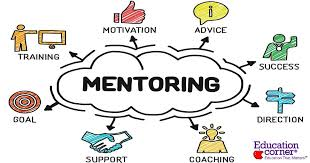
Coaching and mentoring teachers is extremely important for growing teacher capacity and increasing teacher retention. There is a lot of research that strongly supports new teachers having a mentor or coach. Student achievement is much higher in classrooms where teachers are supported by a coach or mentor. Below is a graphic with facts about mentoring/coaching.

The impact cycle is an amazing progression to follow when mentoring. Knight (2017) gives us a model with 3 steps including identify, learn, and improve. The first step is always to identify strategies, goals, or the current reality to find a starting place. Just pick one area to focus on at a time. It is best to keep things simple and focus on the most important strategies first and then begin to add more and more over time. Lia (2016) suggests, “Don’t provide a long list of things the teacher needs to change, but rather focus on one – maybe two – specific changes that are possible in her classroom and provide resources and tips on how to accomplish this.” This will help keep teachers from becoming overwhelmed and stressed out. Chunking these goals and strategies allows new teachers the opportunity to improve a little at a time.When coaching other teachers, it is extremely important to provide teachers with strategies that they can put into practice in their classrooms immediately. This has been helpful for the teacher that I am coaching this year. She is brand new, and has a lot to learn but focusing on individual goals at a time keeps her from being overwhelmed.

The next part of the cycle is to learn. Checklists and modeling are great ways to help teachers learn. Knight (2017) explains that “Checklists make it easier for coaches to clearly describe teaching practices” (p.106). These checklists would be similar to a rubric for good teaching practices. Rubrics are commonly used with students to help provide clear expectations for assignments. Checklists can work similarly to help create clear expectations for teachers as well. It can help give a detailed picture of what should be seen in the teachers classroom on a daily basis. When a new teacher understands what they are doing well and what they could do better, growth and improvement begins to take place and that teacher's capacity will begin to expand.

The last part of the impact cycle is improve. This involves giving feedback, direction, and actions for improvement. According to Lia (2016), “The challenge with teacher feedback has to do with who is giving it, how it is given, when it is given, and how the information is used” (para. 3). We want to make sure that feedback is given at a time and in a way that will be most impactful and well received. This will also be the reflection piece and will drive how to move forward in the cycle. Do you identify a new way to reach the same goal or identify a new goal or strategy to work on.

The impact cycle can be use to help coach teachers on using technology-based instructional strategies. To begin, the coach and teacher would need to decide together what technology-based strategies need to be implemented; whether that is using student engagement apps like Kahoot or using Flipgrid for student presentations. Whatever the strategy or tool may be, the next step would be for the teacher to learn more about it either from their coach or through professional development opportunities. Finally, the next step would be to improve by reflecting on how the tool or strategy worked. This would also involve feedback for the coach.

References

Knight, J. (2017). The Impact Cycle: What Instructional Coaches Should Do to Foster Powerful Improvements in Teaching (1st ed.). Corwin.

Lia, M. (2016). Using An Observation Coaching Checklist to Provide Feedback to Teachers. Journal of Catholic Education, 20 (1). http://dx.doi.org/10.15365/joce.2001152016

Thursday, October 3, 2024

Coaching Methods and Improved Student Achievement

According to Hughes (2024), “Research indicates that in the United States, approximately one-third of teachers in public schools exit the profession within five years of obtaining their teaching qualifications, highlighting a significant retention challenge in the American education system” (para. 4). 


One of the ways that educators can help battle this is by instructional coaching (Knight et al., 2018). Instructional coaches partner with new or struggling teachers to determine their current reality, set goals for improvement, develop teaching strategies to meet goals, and offer support throughout the process. Coaches coming alongside teachers as a partner helps provide a safe space for the new or struggling teacher to discuss and learn from their mistakes. Instructional coaches are non-judgmental and coworkers who are equal in status (Knight, 2017).


My instructional coach, or mentor as we called it, when I was a new teacher had a huge impact on my teaching career. She filled me in on things that were important for me to know and coached me through many different learning experiences I had during my first year. She was great about listening to me when I was stressed, frustrated, or just struggling. She would ask great questions to make me think about how I could adjust or change the situation instead of just telling me how she would handle it. She observed my teaching several times and gave me extremely helpful feedback. I felt supported all throughout my first year of teaching instead of on an island by myself trying to survive the year.


According to Johnson (2016), it is important that the lines between the role of an instructional coach and an administrator are not blurred. New or struggling teachers need to feel that it is safe to talk to their instructional coach about things that they are finding difficult in their classroom without feeling like they are being observed and their job will depend on what they are saying. Teachers must be able to trust their instructional coach so that they can be honest in order for true learning and real growth to take place.


Good coaching, according to Knight et al. (2018), includes seven partnership principles; equality, choice, voice, dialogue, reflection, praxis, and reciprocity. Instructional coaches who use these principles help their collaborating teachers feel like they are professionals and in charge of their own teaching and learning. This allows for teachers to do the thinking for themselves and learn from the thought process used when problem solving. It is a partnership between teachers who learn from each other and ultimately make a difference in the lives and education of their students.


Instructional coaches or mentors help foster effective teachers and good, effective teachers have an impact on student achievement. When new or struggling teachers grow in their confidence and knowledge of their content and ability to teach, student achievement will increase. According to Will (2020), “If new teachers are paired with high-quality, trained mentors and receive frequent feedback, their students may receive the equivalent of up to five months of additional learning, a new study found” (para. 1). When schools implement an effective mentoring program, retention rates increase as well as student achievement.


References:

Johnson, K. G. (2016). Instructional Coaching Implementation. Journal of School Administration Research and Development, 1(2), 37–40. https://doi.org/10.32674/jsard.v1i2.1917


Knight, J. (2017). The Impact Cycle: What Instructional Coaches Should Do to Foster Powerful Improvements in Teaching (1st ed.). Corwin.


Knight, J., Knight, J. R., & Carlson, C. (2018). The Reflection Guide to the impact cycle what instructional coaches should do to foster powerful improvements in teaching. Corwin.


Will, M. (2020, November 19). Mentors for new teachers found to boost student achievement-by a lot. Education Week. https://www.edweek.org/leadership/mentors-for-new-teachers-found-to-boost-student-achievement-by-a-lot/2017/06 

Tuesday, July 30, 2024

Instructional Design

After spending time in this course, I have learned so much about instructional design. Good instructional design is making sure that trainings are designed with the learners in mind and designer has taken into account the effectiveness of the different methods, materials, and technology. When choosing a topic, the designer should be sure to choose a topic that is relevant and necessary for the audience. To begin designing, there are various helpful models to walk you through the design process; such as, the ADDIE Model, The SAM Model, Learning Circle Framework, etc. These are new to me and something I learned about in this class. Having a model is extremely helpful!


There are also many components that should be considered to make sure that the best learning is taking place. Components like color, slide arrangement, text and font use, visuals, etc. Reynolds (n.d.) gives several very helpful tips for good instructional design. The first is to keep it simple; the slides in your presentation should not be cluttered and distracting, but simply display text, data, visuals, etc. to support your instruction. Another tip is to keep it visual; people tend to remember pictures are better than words. Do not create what Reynolds (n.d.) called "sliduments"; this is when slides are turned into documents that contain entirely too much information. Using short video or audio clips can also be helpful; it changes the pace and breaks up the presentation a bit which can help keep the attention of the audience. Brown and Green (2024) said, "Visual design is both an art and a science, and there are trends and fashions in the world of visual design that are worth keeping up with" (p. 247). Doing some research and keeping up with the latest trends can be helpful in creating good instructional design.


To develop the training I designed for this course, I used the ADDIE model that is explained in the graphic below. I will have to wait to finish the implementation and evaluation piece once I get a chance to present my training.


The training is about using success criteria in the classroom along with the current learning targets that we are already using as a school. The training was designed for our faculty. Success criteria will be a school wide focus this year as we work towards helping students understand why they are learning the things that they are learning. Which was the start of a good instructional design process because I know that this training is something that our faculty need to learn about and will benefit the students in our school. Our students are so focused on the grade that is attached to assignments and we would like to shift their thinking to working towards achieving goals. While creating my slides, I was sure to keep it simple and make sure that they were not cluttered and contained beneficial information. I want the slides to support what I am discussing in the training and not be overstimulating to the point that they are a distraction. I also used a consistent color scheme, font, and design throughout the entire presentation. When looking back through my presentation, I think in the future I will try to incorporate more visuals and data but still be sure to keep the design aesthetic.


Link to my training materials - https://sites.google.com/shelbyed.org/successcriteriapd/home


References

Brown, A., & Green, T.D. (2024). Essentials of instructional design: Connecting fundamental principles with process and practice. Routledge.


Reynolds, G. (n.d.). Design tips. Presentation Zen Design Tips. https://www.garrreynolds.com/design-tips

Wednesday, July 17, 2024

Instructional Strategies for Professional Development

Professional development, or training for teachers, is much like teaching a group of students. It is important to think about the different types of learners and incorporate instructional strategies that meet their needs as well as help everyone understand the content that is being taught. One strategy that can be used is reciprocal teaching and another is think-pair-share. Both strategies encourage participants to engage in discussions with their peers to help further understand the material being taught or discussed. There are times that both students and teachers alike learn better from each other than they do from direct instruction.


Reciprocal teaching can improve reading comprehension. Group participants each have a job; the summarizer, the questioner, the clarifier, and the predictor. This allows participants to take turns leading the discussion and actively engage in the content. Participants start by reading the passage and highlighting or taking notes that help prepare them for their part in the discussion. The summarizer will then highlight key points that are important for understanding the passage. The questioner will then ask questions that may be unclear or help make connections to other content. The clarifier will then help answer questions that were asked. Finally, the predictor will then make predictions about what will happen next in the passage (Anonymous, n.d.). According to McCallum (2014), “Reciprocal teaching is inclusive and enables teachers to use evidence gained through the reciprocal conversations to continually adjust and target teaching to meet the needs of diverse students” (p. 32).


Below is a video showing an example of this strategy being used in a classroom.  


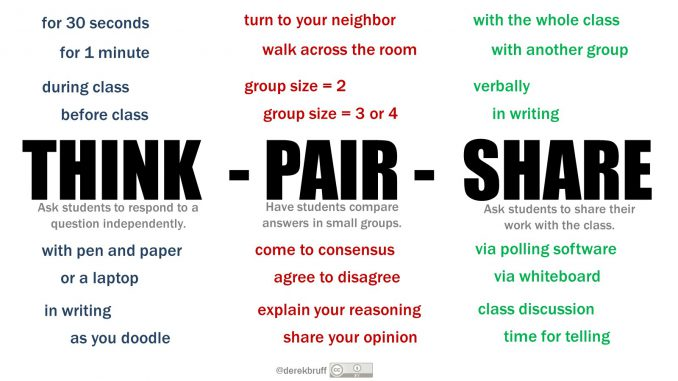
Another strategy that is great to use is think-pair-share. Using this strategy, participants will work together to either solve a problem or answer questions about a lecture, whole group discussion, or a passage. Think-pair-share can help participants engage with the content and better understand what is being taught. Participants spend some time thinking about a topic on their own and also spend time discussing it with a partner; this can help expand their learning and sometimes even help them better understand when discussing it with a peer (Kerley et. al., n.d.). According to Yusef et. al. (2018), “Students taught using Think-Pair-Share strategy performed better than those taught using traditional (lecture) strategy” (p. 57). I have used think-pair-share many times when teaching students. We will discuss a topic and I usually ask them a question to think about on their own for a short amount of time and then have them turn and talk to a neighbor and compare their thoughts. 


References

Kerley, B., Rumford, J., & Shulevitz, U. (n.d.). Think-pair-share. Reading Rockets. https://www.readingrockets.org/classroom/classroom-strategies/think-pair-share#:~:text=Think%2Dpair%2Dshare%20is%20a%20collaborative%20learning%20strategy%20where%20students,2)%20share%20ideas%20with%20classmates. 

McAllum, R. (2014). Reciprocal teaching: Critical reflection on practice. Kairaranga, 15(1), 26–35. https://doi.org/10.54322/kairaranga.v15i1.183 

Reciprocal teaching. Reading Rockets. (n.d.). https://www.readingrockets.org/classroom/classroom-strategies/reciprocal-teaching#:~:text=Reciprocal%20teaching%20is%20a%20cooperative,the%20comprehension%20of%20a%20text. 

Yusuf, A., Owede, V. C., & Bello, M. B. (2018). Effect of think-pair-share instructional strategy on students’ achievement in Civic Education in Bayelsa, Nigeria. Anatolian Journal of Education, 3(2). https://doi.org/10.29333/aje.2018.325a

Tuesday, April 30, 2024

Field Assignment 2 - Professional Development

For my OPL, I chose to respond to instructional focus and professional development 4A which is plan for and coordinate ongoing, purposeful professional development. This year I co-led a PLC PD group for new teachers at our school. Our curriculum and instruction committee decided for our professional development goal for the year that we would host teacher led professional development. There are so many great things happening in our building that we can learn about from one another. Our focus for the professional development was on certain elements from Marzano’s book The Handbook for the New Art and Science of Teaching. Pairs from the committee each chose an element to host PD on throughout the year. Returning teachers were able to sign up for the element of their choice to focus on and learn about while new teachers were all placed in our group and we focused on rules and procedures. With our group of new teachers, our focus was on rules and procedures. We learned about, discussed, and reflected on successful rules and procedures. We planned for and led professional development for this group every other month throughout the school year. At our last teacher work day, we did gallery walk to share the many things that were discussed in our PLC PD group with other groups. Our group had many amazing rules and procedures that even veteran teachers had not used and were willing to try in their classrooms.

Teacher led PD can be extremely beneficial and also cost effective. Stebick et al. (2023), discusses how the most effective way to engage teachers in effective professional development is to provide a safe space for discussion. What more of a safe space can you find for discussion than that of a space among your peers?

Blog on teacher led professional development

        Teacher led professional development fits right in with the professional learning that is discussed in our textbook. Sheninger (2019), mentions that a shift to professional learning, which consists of collaborative, job-embedded learning, is necessary for the adequate growth of educators. As we collaborated in our PLC PD group, we all learned from each other some great rules and procedures to take back to our classrooms. For example, many of our teachers are having issues with students using phones during class and one teacher shared about her procedure for turning in phones in order to get their notes, work, or test for the day. Stebick et al. (2023), mentions that teachers often seek authentic professional development led by other teachers in the classroom. Furthermore, Sheninger (2019) shared the image below that shows what teachers want for professional learning. Teacher led professional development helps fulfill so many of the desires shown below.

        After our PLC PD came to an end, we conducted surveys to get opinions on how teachers in our group felt about their learning from the year. The majority expressed that they enjoyed the discussions that took place and learned so much from their peers. They felt that learning more about rules and procedures and ideas to use in their classroom was beneficial and worthwhile. 


Sheninger, E. (2019). Digital leadership: Changing paradigms for changing times.
Corwin.

Stebick, D., Hart, J., Glick, L., Kindervatter, J., Nagel, J., & Patrick, C. (2023). Teacher Inquiry: A Catalyst for Professional Development. Networks: An Online Journal for Teacher Research, 24(1).

Continuity Plans in Education

Being a part of education during the shut down of Covid-19 taught us so many things. Crisis schooling is a real thing and we have to be prep...